

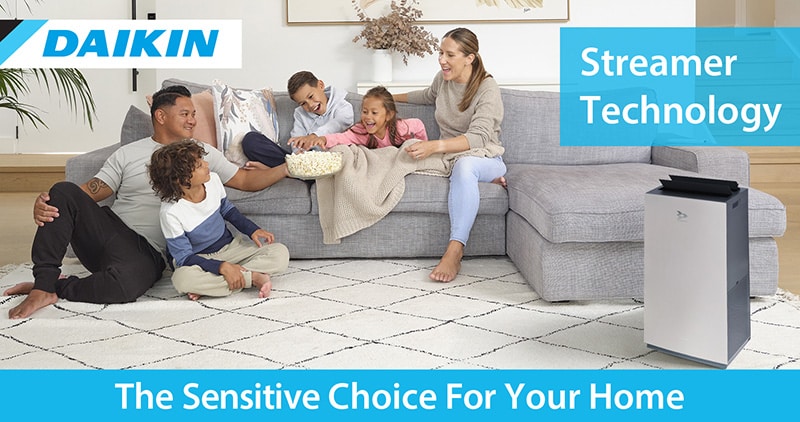
Air Purifiers
Breathe Cleaner, Healthier Air – Special Offer Available!
Transform your home into a haven of fresh, purified air with Daikin’s advanced range of Air Purifiers. Featuring market-leading Streamer Technology, these devices remove more than 99.9% of common allergens, bacteria, mould, odours, and even viruses like Influenza A and Coronavirus (HCoV-229E). With four layers of filtration, real-time air quality monitoring, and ultra-quiet operation, Daikin Air Purifiers offer powerful protection for your family’s health — backed by the trusted quality of Australia’s No.1 air conditioning brand.
Take advantage of our limited special pricing today and enjoy a cleaner, fresher, and healthier home all year round!
MC30YPVM
MODEL- AREA – 46m²
- ROOM TYPE – Small – Medium Size Bedroom or Office.
- APPROX ROOM SIZE – 7m x 7m room
MC40YPVM
MODEL- AREA – 62m²
- ROOM TYPE – Large Bedroom, Rumpus Room or Large Open Plan Office.
- APPROX ROOM SIZE – 8m x 8m room
MC55YPVM
MODEL- AREA – 82m²
- ROOM TYPE – Large Open Plan Living Room or Very Large Open Plan Office.
- APPROX ROOM SIZE – 9m x 9m room
MCB80ZPVM
MODEL- AREA – 124m²
- ROOM TYPE – Very Large Open Plan Room or Very Large Open Plan Office.
- APPROX ROOM SIZE – 11m x 11m room
FAQ’s
- What does an air purifier do?
An air purifier removes contaminants from the air, including dust, pollen, smoke, pet dander, mold spores, and certain bacteria and viruses.
- Do air purifiers really work?
Yes, quality air purifiers with HEPA and activated carbon filters can effectively remove many airborne particles and odors.
- What is a HEPA filter?
HEPA stands for High-Efficiency Particulate Air. It can trap at least 99.97% of particles as small as 0.3 microns.
4.What is DAIKIN Streamer Technology?
This innovative technology features a high-power plasma discharge that generates high-speed electrons to decompose harmful substances. This powerful oxidative decomposition process continuously removes odours, bacteria and indoor air pollutants, such as formaldehyde, for superior air purification.
Usage and Maintenance
- How often should I run my air purifier?
It’s best to run it continuously, especially if you have allergies or respiratory issues. Use the lowest setting when sleeping to reduce noise.
- How often should I change the filters?
HEPA filters typically last 6–12 months; carbon filters may need replacement every 3–6 months. Follow the manufacturer’s recommendations.
- Where should I place my air purifier?
Place it in the room where you spend the most time (like the bedroom or living room), ideally near a source of pollution and away from obstructions.
- What is the Warranty Period for a Daikin Air Purifier?
12 Months (see Warranty Card)
Health and Safety
- Are air purifiers safe to use around pets and children?
Yes, most are safe. Avoid models that emit ozone, as it can be harmful.
- Can air purifiers help with allergies or asthma?
Yes, especially those with HEPA filters, which capture common allergens and irritants.
- Do air purifiers remove viruses or bacteria?
HEPA filters can trap many bacteria and virus-sized particles, but not all. Some purifiers have UV-C or other technologies that may neutralize them.
Technology and Features
- What’s the difference between HEPA, activated carbon, and UV filters?
- HEPA: Captures particles (dust, pollen, dander)
- Carbon: Removes gases and odors
- UV-C: Aims to kill or deactivate microbes
- Do air purifiers remove odors?
Yes, models with activated carbon filters are effective at removing common household odors.